Reviewing the “You Can’t Scare Me” Mom Design
As a designer who spends half my life digitizing and the other half stitching, I have learned to look past the initial charm of a graphic. We see thousands of files weekly, but few make the cut for serious commercial embroidery projects. Today, I am putting the You Can t Scare Me I m a design under the microscope. This is not just about whether it looks cute on a screen; it is about how it behaves when needle meets fabric in a real-world embroidery project.
First Impressions and Visual Personality
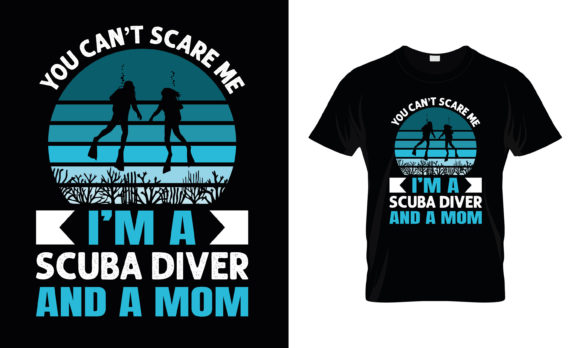
The phrase “You can t scare me I m a scuba diver and a mom” carries a specific attitude. It is bold, humorous, and resilient. Visually, this type of T-Shirt Designs category item relies heavily on typography and layout balance. When I first opened the file, I looked for clean lines and logical breaks in the text. A design like this needs to breathe. If the letters are too cramped, the machine will struggle with registration, and the human eye will struggle to read the joke.
The mood here is playful defiance. It fits perfectly into the niche of personalized gift items for mothers who have active hobbies. It is not delicate or floral; it is statement-making. For an Etsy seller or craft business owner, this means the target audience is likely looking for something that stands out on a tote bag design or a casual hoodie. The visual personality suggests durability and fun, which aligns well with the scuba diving theme.
Real-World Application: The Tote Bag Test
To evaluate this properly, I imagined a specific scenario: a custom order for a canvas tote bag. Canvas is a forgiving fabric, but it has a distinct weave. I visualized placing the You Can t Scare Me I m a graphic centrally on the bag. Because the design includes the concept of a scuba diver, there might be graphical elements accompanying the text. In my mental mockup, I considered how a satin stitch border would hold up against the rougher texture of canvas compared to a smooth cotton twill.
If this were a sweatshirt embroidery project, the outcome would differ. Fleece and french terry have pile. Small details can get lost. I would advise any small shop product creator to test this design on a scrap piece of their actual garment stock. Does the text remain legible? Does the “scuba diver” element, if present, look like a blob or a recognizable shape? These are the questions that determine whether a customer keeps the item or returns it.
Technical Considerations for Stitchers
Let us talk about the mechanics. The product description notes that this digital asset comes in EPS, SVG, and PNG formats. This is crucial information. As an experienced reviewer, I must point out that these are primarily vector and raster image formats, commonly used for cut machines, vinyl decals, and printing. They are not native machine embroidery formats like DST or PES.
This distinction matters immensely for your workflow. If you are an embroidery designer, you will likely need to use these graphics as a reference to manually digitize the design or use auto-digitizing software with caution. Auto-digitizing often fails with complex text and small icons, leading to excessive stitch density and thread breaks. You must check the stitch density yourself. High density on a thin fabric will cause puckering. Low density on a thick fabric might show the background material through the stitches.
For those using this for vinyl decals or scrapbooking, the SVG and EPS files are ideal. They scale without losing quality. However, for machine embroidery design purposes, you are starting from a graphic source. You need to decide between a fill stitch for larger areas or a running stitch for fine details. Remember, tiny lettering in a running stitch can unravel if not backed properly.
Fabric and Hoop Constraints
Where should you avoid using this design? I would be cautious with very small hoop size constraints if the full phrase is included. Compressing “You can t scare me I m a scuba diver and a mom” into a 4x4 inch hoop will render the text unreadable. This design demands space. It belongs on a chest pocket of a large jacket, the back of a shirt, or a full-sized tote.
Also, consider the fabric texture. On dark fabrics, you must ensure your thread colors have enough contrast. A light blue thread on navy blue might vanish. Use a stabilizer that matches the fabric weight. For stretchy fabrics like jersey t-shirts, a cut-away stabilizer is non-negotiable to prevent distortion after washing. If you are making a baby embroidery item, ensure the backing is soft and no scratchy edges remain, as babies have sensitive skin.
Commercial Viability and Brand Trust
Why does this design sell? It taps into identity. Moms who dive are a specific community. By offering this as a custom apparel option, you are validating their dual identity. This builds customer trust and brand loyalty. When a buyer sees a well-executed finished product, they perceive higher value. Sloppy stitching or illegible text undermines that value instantly.
For digital product sellers, offering this as a ready-to-cut SVG is a low-overhead income stream. For handmade product creators, it requires more labor but commands a higher price point. Always verify the license terms. Just because you bought the digital file does not always mean you can sell unlimited physical goods. Check the creator’s terms for commercial embroidery usage.
Final Designer Notes
Before you launch this in your small shop product line, take these steps:
- Test on scrap fabric: Never skip this. See how the threads interact with your specific material.
- Check contrast: View your design in black and white. If the details disappear, your color choice is too subtle.
- Verify file utility: Remember, EPS/SVG/PNG are for cutting/printing. You may need to digitize for embroidery.
- Consider the wash: Will the design survive hot water? Secure your threads properly.
- Mockup wisely: Use realistic printable mockup tools to show customers how it looks on a curved surface like a cap or a flat surface like a pillow.
The You Can t Scare Me I m a design has potential. It is spirited and relevant. However, its success depends entirely on your technical execution. Treat it with the respect a good design assets library deserves, and it will become a staple in your holiday embroidery or everyday custom apparel offerings. Do not rush the digitizing process if you are converting from vector. Precision is what separates a hobbyist from a professional apparel decorator.